
The hotel room is changing. Where a decent bed, WiFi and a television were for years the key amenities, hotels are increasingly investing in smart technology that allows guests to tailor their stay more to their own preferences. Major international hotel chains are expanding their offering of connected rooms, and scientific research also shows that smart hotel technology is playing an ever greater role in the guest experience.
Audio fits well within this development. Guests take their smartphones, favourite streaming services and personal playlists everywhere with them. By giving them easy access to their own music in the hotel room as well, the room becomes more personal without the need for complicated technology.
Smart hotel rooms are increasingly becoming the norm
That connected hotel rooms are no longer a thing of the future is clear from developments at major hotel chains, among other things. Hilton reports in its 2026 Trends Report that the number of digitally connected hotel rooms worldwide grew by 53% between August 2024 and August 2025. Meanwhile, 5.1 million Hilton guests use entertainment and wellness apps monthly via the Connected Room Experience. Entertainment is the most used form of content.
Marriott is also investing further in the connected hotel room. Marriott International and LG Electronics announced in September 2026 that they have jointly developed a new cloud platform for entertainment and technology in hotel rooms. The system is first being tested in 40 hotels in the United States and Canada, with the aim of further international rollout.
The direction in which the market is moving is therefore clear. Technology is increasingly becoming a structural part of the hotel room. As guests encounter these facilities at more hotels, their expectations change too.
Research: smart technology can contribute to a better guest experience
That Hilton and Marriott are heading in this direction is not surprising, as it is supported by recent scientific research. A study from August 2026 examined online reviews of hotels in the United Arab Emirates and looked specifically at smart hotel technology. Think of mobile check-in, keyless entry, smart-room controls and digital concierge services.
The researchers found a positive correlation between the presence of smart technology, the perceived quality of the stay and the hotel’s rating. Technology that delivers convenience, enables personalisation and reduces friction during the stay proved particularly relevant to the guest experience. An important nuance is needed here. The research shows a correlation and does not prove that any single technology automatically leads to a higher rating. It does, however, demonstrate that well-applied technology can form part of a more positive hotel experience.
Technology must above all be simple
Adding more technology is not automatically better. The technology must genuinely add something for the guest and be simple to use. This is also apparent from a second study, published in February 2026 in the International Journal of Hospitality Management. The researchers examined both the acceptance of connected-room technology by hotel guests and its possible influence on hotel performance.
Two factors proved especially important for acceptance: the benefit that guests themselves experience and the extent to which the technology fits existing habits. Complexity, by contrast, had a restraining effect.
Audio via Bluetooth is a familiar and low-threshold technology in this regard. It has been used for years to connect smartphones to wireless speakers, cars, headphones and other devices. For most guests, pairing their phone via Bluetooth is therefore a familiar action. That existing habit can be continued in the hotel room as well. Guests use their own smartphone and continue listening via the music apps and streaming services they already use daily.
From hotel technology to personal technology
For years, hotels largely determined which entertainment options were available in the room. The television and available channels, for example, formed the starting point. That is changing. Guests bring their own digital environment with them. They use their own smartphone or tablet, have their own streaming subscriptions and have personal music, podcasts and playlists immediately to hand. The role of the hotel room is therefore shifting. The hotel does not need to provide all the content itself, but must primarily make it easy for the guest to use their own content.
With video, this is increasingly happening via streaming and casting. For music, Bluetooth offers the same possibility. With Bluetooth hotel speakers, a guest can connect their smartphone and immediately play music via Spotify, Apple Music or another audio source. The room thus aligns better with the digital behaviour that guests are already used to at home.
Audio gives guests more control over their own room
Music is personal. One guest may want to relax quietly after a long journey, while another wants to play their favourite playlist while getting ready. With audio in the hotel room, the guest decides for themselves what atmosphere they create. This ties in with an important conclusion from the research into smart hotel technology: technology delivers the most value when it makes the experience easier and more personal.
Bluetooth audio is a relatively simple application of this, with a positive effect on hotel reviews. In an earlier article we already looked at various reviews in which guests explicitly mentioned Bluetooth audio as a positive part of their stay.
Why an ordinary Bluetooth speaker is not the same
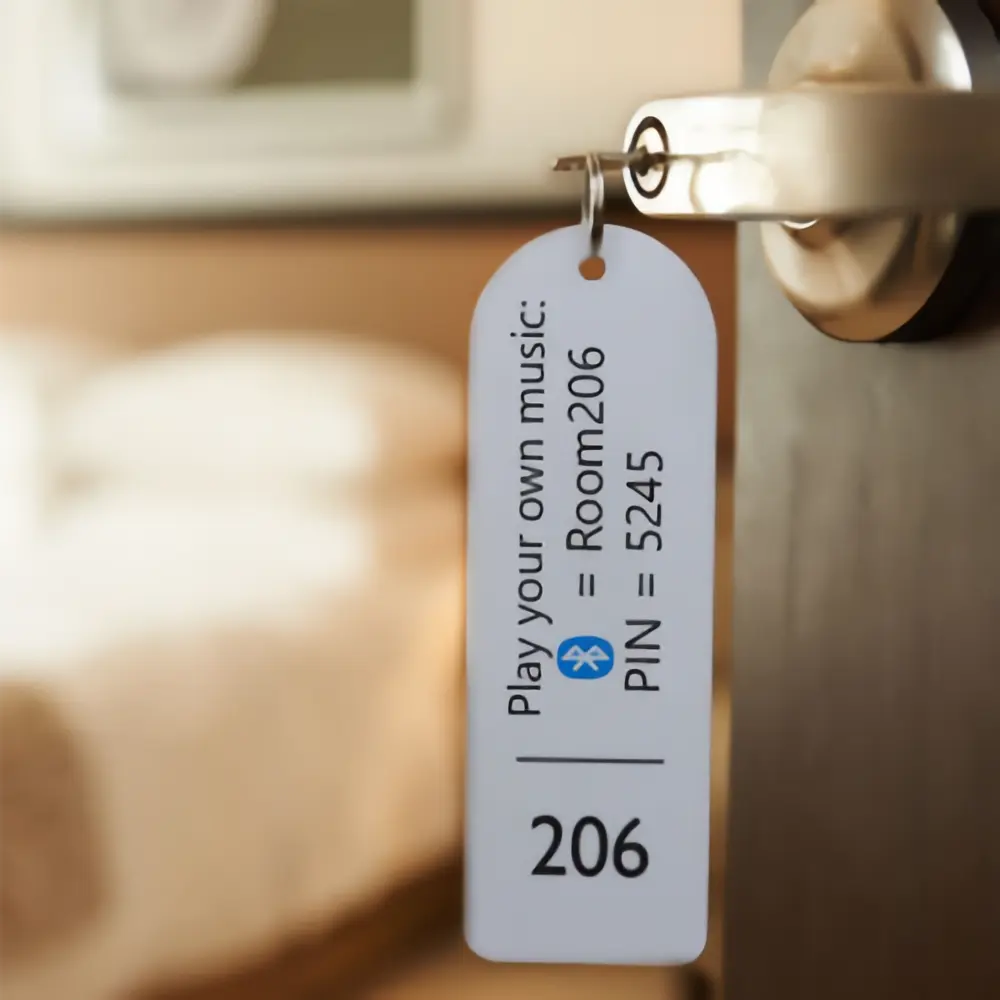
Anyone who wants guests to be able to play their own music could of course simply place a free-standing Bluetooth speaker in the room. For professional hotel use, however, that brings various disadvantages.
Free-standing speakers can be moved or taken away, and the maximum volume is generally not centrally limited. It can also be unclear which speaker a guest should connect to when several rooms use the same equipment. AquaSound hotel speakers are therefore specifically designed for use in individual hotel rooms.
The speakers are built in or securely mounted. In addition, each system can be given its own Bluetooth ID, for example ‘Room 301’. Optionally, a unique PIN code can be set for each system so that guests do not accidentally connect to the audio installation in another room.
The maximum volume can also be limited in advance. This allows the hotel to retain control over possible noise disturbance, while the guest can play their own music within those limits.
Built-in or added later
Investing in hotel-room technology does not necessarily mean that an entire room has to be renovated.
With AquaSound, both in-wall/ceiling and surface-mounted speakers can be chosen. In-wall speakers can be discreetly integrated into a ceiling or wall during a renovation. When an existing hotel room does not need major alterations, surface-mounted speakers can be a practical alternative. Whatever stage you are at, AquaSound has audio solutions that match your requirements.
Tip: Are the hotel rooms being renovated? Then it is wise to include audio early in the room design. Cabling and speakers can then be integrated more easily in the desired locations. You can read more about this in this article.
Did you know, by the way, that our audio can go further than just the bedroom? AquaSound also offers solutions for hotel bathrooms, private wellness areas, saunas and other spaces where moisture or higher temperatures play a role.
What does the move towards connected rooms mean for hotels?
Not every hotel needs to develop a fully connected-room platform like Hilton or Marriott. The underlying development is nevertheless relevant for smaller hotels too. Guests are becoming accustomed to technology during their stay aligning with the devices and services they themselves use daily. At the same time, research shows that simplicity, compatibility and a clear benefit for the guest are particularly important for the acceptance of hotel technology.
Audio is a concrete way of responding to this. The technology is familiar to the guest, connects with existing smartphones and streaming services, and can become part of the room experience without complicated controls. Meanwhile, hotels retain control over matters that are important in a professional environment, such as volume, connection and fixed installation.
Wait until guests expect it, or invest now?
The smart hotel room is not something for the distant future. Major hotel chains are already rolling out connected-room technology on a large scale today. Hilton expanded the number of connected rooms by 53% in recent years, and Marriott is currently working on a platform that, after the initial pilot, should be capable of international rollout.
Scientific research from 2026 also points in the same direction. Guests value technology when it makes the stay easier and more personal and aligns with habits they already have. That does not mean that every new technology automatically belongs in a hotel room. The question is primarily which applications genuinely add something to the guest’s experience.
Hotel audio fits within this development because it makes a familiar action easier: your guests listen to their own music, on their own phone and via their own streaming service, but with the comfort of integrated speakers in the hotel room.
Would you like to know which audio solution suits your hotel rooms? View the possibilities of AquaSound Hotel Audio or discuss your project with our specialists, free of obligation.