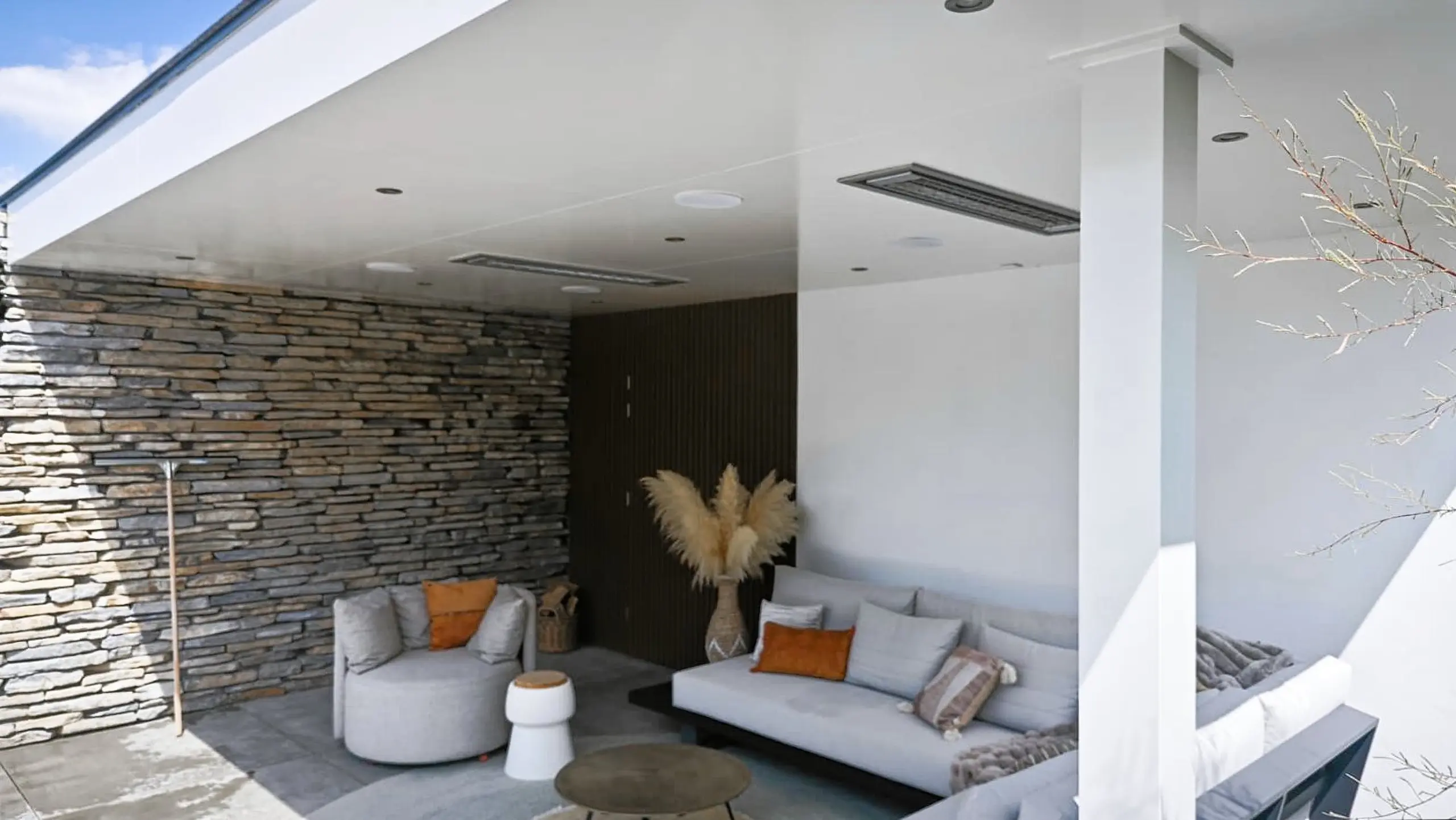
Music in the garden instantly creates atmosphere. During a quiet morning on the terrace, a dinner with friends, an afternoon by the pool, or an evening under the canopy, good sound makes outdoor living more comfortable. However, audio works differently outdoors than indoors. The space is more open, sound spreads faster, and factors such as wind, distance, moisture, and ambient noise have a greater influence.
That is why music in the garden is not just about choosing a speaker. The source of the sound, the direction in which it plays, and the way the sound is distributed across the garden largely determine how pleasant music sounds outdoors.
In this blog, we discuss common solutions for music in the garden. We will then look at situations where fixed outdoor speakers, such as built-in and surface-mounted speakers from AquaSound, are better suited for daily use in the garden.
Music outside sounds different than indoors
Indoors, sound is supported by the space. Walls, floors, and ceilings reflect part of the sound, making music sound fuller and last longer. In the garden, that natural support is much less present. Sound dissipates more quickly in open space and is reflected back to the listening position less.
You will notice this difference especially at a distance. Music can sound clear close to the speaker, while it is already much less present just a few meters away. Low tones and detail in the music also fade away faster outdoors than indoors. As a result, a speaker that has sufficient volume and sound quality indoors may come across differently outdoors.
Therefore, the distribution of sound is important for outdoor use. It is not just the volume that counts, but especially where the sound is placed and how close it remains to the listening position.
Wind, distance, and ambient noise
In a garden, the sound experience changes constantly. On a windless evening, music lingers around the patio more easily. On a windy day, sound is displaced or blown away more quickly. The layout of the garden also plays a role. An open garden, a garden with high fences, a canopy, or a swimming pool all create different acoustics.
Additionally, there is often more ambient noise outdoors than you notice beforehand. Think of people talking, traffic, children playing, birds, a pool pump, a jacuzzi, or garden equipment. Music doesn't need to shout over these noises, but it must remain clearly present enough to sound pleasant.
Distance plays a major role here. A single speaker from one point causes the sound to travel unevenly through the garden. Close by, the volume may be more than sufficient, while further away it becomes softer or less clear. For music in the garden, a quiet, even distribution therefore often works better than a single sound source that has to fill the entire area.
Considering the neighbors
With music in the garden, not only is the listening spot important, but also the direction in which the sound spreads. A speaker aimed at the neighbors or playing loudly in an open area can be heard outside your own garden more quickly. This doesn't necessarily mean the music needs to be quieter, but it does mean that placement is important.
Well-placed garden speakers can keep the sound closer to the desired spot. As a result, the volume doesn't need to be as high, and the music remains better focused on the patio, the covered area, or the swimming pool. For background music, that is often the most pleasant solution: present enough for atmosphere, but not unnecessarily loud.
Fixed speaker locations instead of standalone solutions
Temporary solutions are often used for music in the garden, such as a phone, portable Bluetooth speaker, or radio. That makes sense: you always have a phone at hand. However, built-in speakers are small and primarily aimed at listening up close. Outdoors, the sound quickly lacks volume, dispersion, and clarity. For control purposes, however, a phone works very well. In combination with a Bluetooth or Wi-Fi booster, you use your phone to stream music, while fixed outdoor speakers provide the sound.
A portable Bluetooth speaker can be handy for flexible use, but the limitation lies mainly in placement and its temporary nature. The speaker must be set up, charged, and stored away again after use each time. Additionally, the sound still emanates from a single point. In a small space, that might be sufficient, but on a patio, at a large table, under a canopy, or by a swimming pool, you will notice more quickly that the sound is unevenly distributed.
Then there is the option of bringing a radio outside, but in practice, this also does not fit well with a permanent garden setup. The radio is often placed wherever there happens to be power or shelter, rather than where the sound is best appreciated. With fixed built-in or surface-mounted speakers, you consciously choose speaker locations based on where you want to hear music. This results in a neater and better-placed solution, with the controls you expect from modern audio.
How fixed outdoor speakers make the difference
Fixed outdoor speakers are designed for use in a specific location. That is the biggest difference compared to a freestanding speaker. The sound source is not moved around repeatedly, but is deliberately positioned based on where you want to hear music.
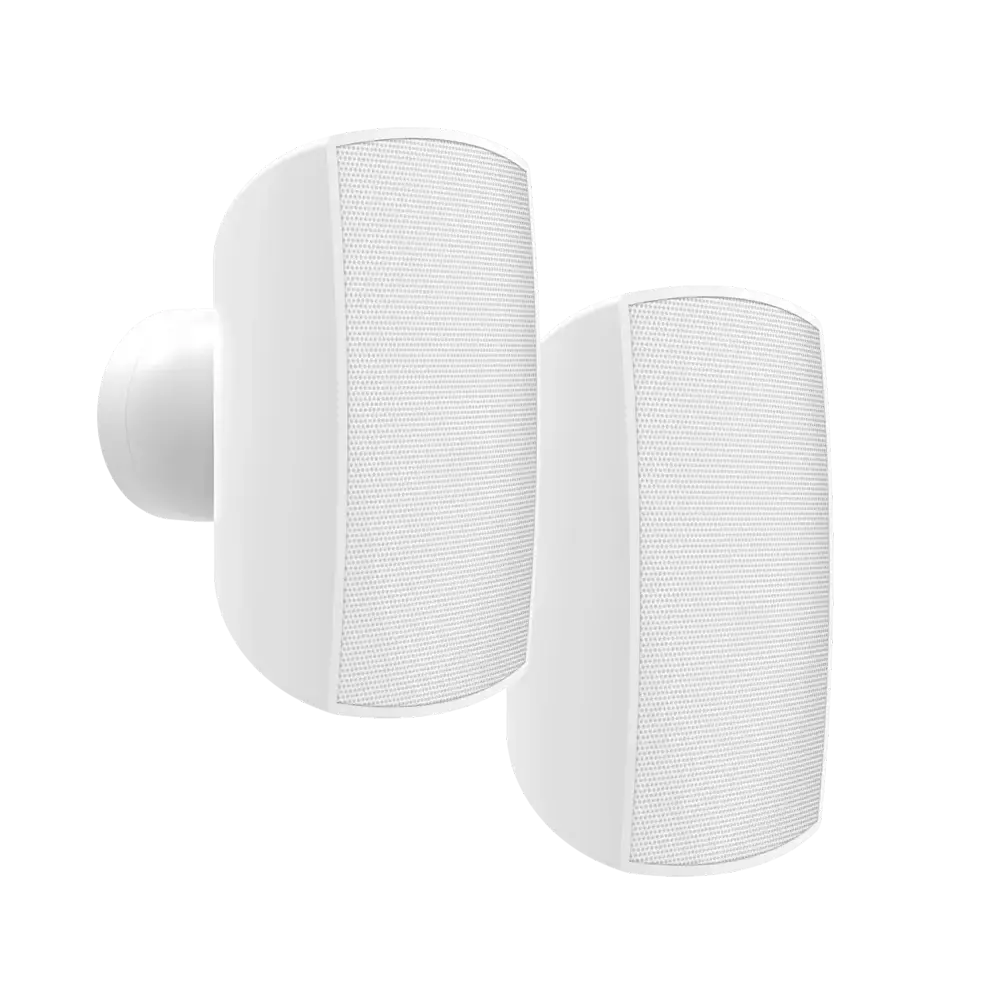
At AquaSound, this is possible with built-in or surface-mounted speakers. Built-in speakers are suitable if your overhang, veranda, pool house, or canopy has a false ceiling. They are neatly concealed and do not take up any visible space. Surface-mounted speakers are suitable for mounting on a wall, facade, beam, or other fixed structure. This makes them flexibly deployable in places where built-in installation is not possible or less logical. In combination with a Bluetooth or WiFi amplifier, operation remains simple. You stream music from your phone or tablet, but the sound comes from speakers designed for permanent placement in the garden. This ensures more tranquility, less loose equipment, and better sound distribution.
Music tailored to the garden situation
For music in the garden, always choose waterproof outdoor speakers. Even on a patio or under a canopy, the speakers remain permanently outdoors. They are exposed to moisture, temperature fluctuations, and changing weather conditions all year round. Which setup is best depends mainly on where you want to hear music, the size of the garden, and the number of listening spots.
| Situation | What is important | Best speaker setup | WiFi / Bluetooth |
|---|---|---|---|
| Terrace at the home | Quiet background music for dining, drinks, or relaxing. The sound must be clearly audible without overpowering conversations. | Usually 2 waterproof outdoor speakers, mounted on the facade, under an overhang, or aimed at the seating area. | Bluetooth is often sufficient for a single compact listening spot close to the home. WiFi is more interesting if you want to stream more stably or add multiple zones later (multiroom). |
| Covered patio or veranda | Even distribution of sound in a clearly defined seating area. The speakers should preferably be as inconspicuous as possible. | ten 2 waterproof built-in speakers in the ceiling. With a larger covered patio, 4 speakers can provide a better distribution. | Bluetooth works well for a simple fixed setup. WiFi is stronger when you use the covered patio frequently or want to combine it with other speakers in the house or garden (multiroom). |
| Swimming pool, Jacuzzi, or wellness area | Moisture, splashing water, and remote control from the water. The sound must be pleasantly audible without placing equipment close to the water. | 2 or more waterproof outdoor speakers by the swimming pool, pool house, wellness area, or under a nearby canopy. | Bluetooth is fine for a simple fixed setup. WiFi is interesting if your network reaches the location and you want to combine this location with other speakers in the house or garden (multiroom). |
| Large garden with multiple seating areas | Distribute sound across multiple zones without turning one spot up unnecessarily loud. Think of a patio, lounge area, canopy, or swimming pool. | For example, 4 to 6 waterproof outdoor speakers, as surface-mounted or built-in speakers, distributed across the main usage areas. | WiFi is usually the best choice. This allows you to control multiple speakers or zones more evenly and fill the garden better. However, ensure that your network covers all locations. |
| Long garden or second seating area further away from the house | Sufficient coverage at a distance from the rear facade. Speakers placed only near the house often have too little effect at the back of the garden. | Also place speakers closer to the second seating area, outdoor kitchen, pergola, or pool house. | WiFi is usually more practical, provided the Wi-Fi coverage in the garden is good. Bluetooth is less suitable for longer distances or when pairing multiple speakers. |
| Outdoor kitchen or dining area | Atmospheric sound around the area where eating or cooking takes place, without the music being too obtrusive. | 2 waterproof outdoor speakers aimed at the dining area or subtly distributed around the outdoor kitchen. | Bluetooth is suitable for a compact dining area. Wi-Fi makes more sense when the outdoor kitchen is part of a larger garden setup or when you also use Wi-Fi speakers inside the house. |
The right choice therefore lies not only in the type of speaker, but primarily in the distribution. For a compact canopy, 2 waterproof built-in speakers are often sufficient for a pleasant sound experience. For a larger terrace or a garden with multiple seating areas, more comfort is achieved when you distribute the sound across 4 or 6 speakers. Bluetooth is suitable for simple setups with a single clear listening spot. WiFi is better suited for larger gardens, multiple zones, and situations where you want to stream music more stably and flexibly.
Every AquaSound speaker can be connected to a WiFi or Bluetooth amplifier. So you can simply choose your desired waterproof speaker, and then select the connection method.
Built-in or surface-mounted outdoor speakers
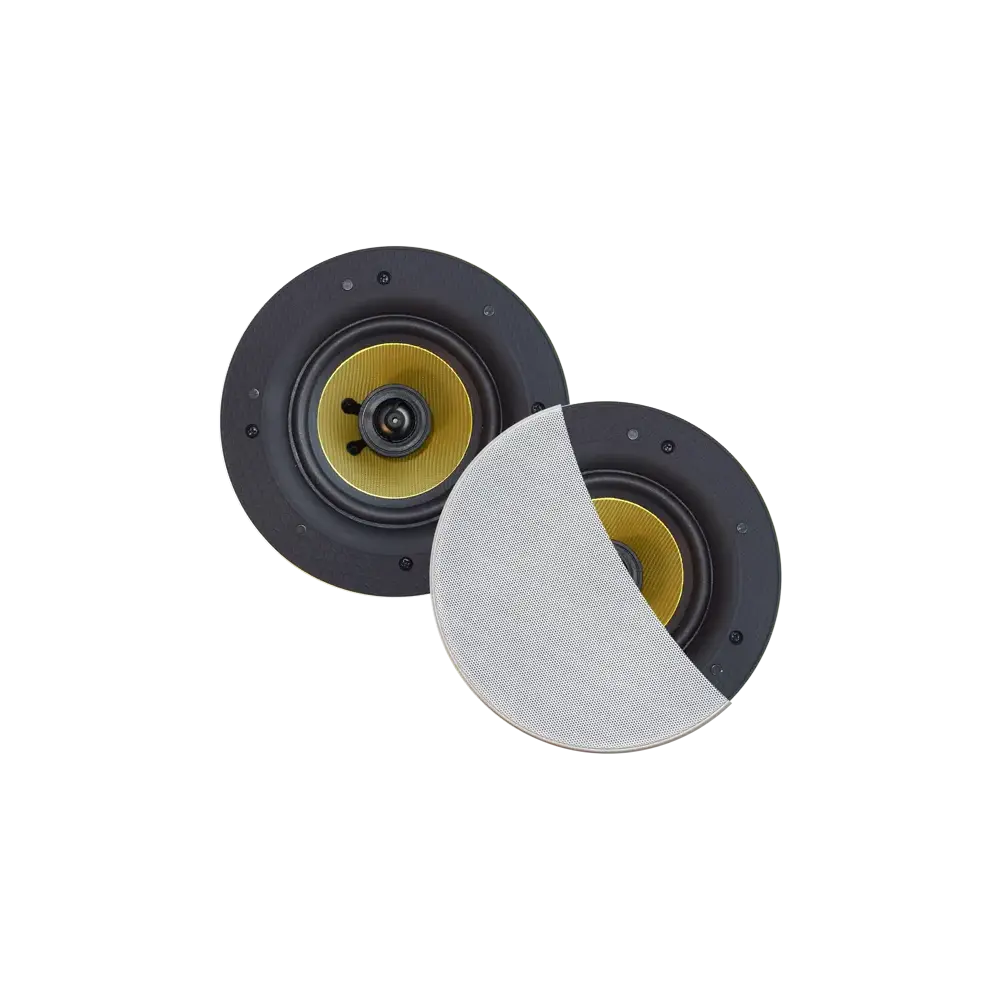
The choice between built-in and surface-mounted depends mainly on the structural situation. Built-in speakers can be used with a canopy, veranda, outdoor ceiling, or pool house with a false ceiling. They are neatly concealed and provide a sleek result. For gardens where the audio installation should be as invisible as possible, this is often the most aesthetically pleasing solution. Surface-mounted speakers are suitable when a false ceiling is not available or when mounting to a wall, facade, or beam is more practical. They are more visible than built-in speakers but can be positioned precisely and are versatile for use in various garden situations.
Both solutions can be combined with a Bluetooth or Wi-Fi amplifier. This makes the garden part of the same ease of use you are accustomed to indoors: choosing music from your phone, without being dependent on the small speakers in your phone or a separate portable speaker.
Conclusion: Music in the garden requires proper placement
Music in the garden is enjoyable when the sound suits the space. Outdoors, wind, distance, ambient noise, moisture, and neighbors all play a role. Therefore, not only is the speaker itself important, but especially the location from which the sound originates.
A phone, portable Bluetooth speaker, or radio may be suitable for occasional use. For those who want music regularly on the patio, under a canopy, or by the pool, fixed outdoor speakers offer more comfort. With AquaSound built-in or surface-mounted speakers and a Bluetooth or WiFi amplifier, you combine simple operation with a neat, fixed, and better-distributed sound solution for outdoors.